![[logo] HealthTree Foundation](https://static.healthtree.org/icons/icon_spinner.svg)
![[logo] HealthTree Foundation](https://static.healthtree.org/logo_icon_only.svg)
Rethinking Myeloma Drug Approvals: Why Patients’ Voices on MRD Matter



Over the past decade, multiple myeloma treatment has dramatically improved. Thanks to new therapies like CAR T-cells and bispecific antibodies, patients are living longer. But this success has created a new challenge: waiting.
Today, it can take 10 to 15 years to prove that a new drug improves progression-free survival (PFS) or overall survival (OS) in the first-line setting. That means many patients may never get access to promising therapies while the data slowly matures.
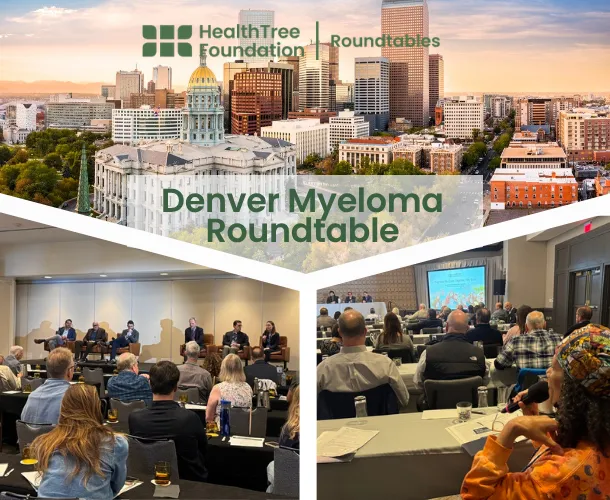
At a recent panel discussion, experts from around the world came together to tackle a big question:
-
Jenny Ahlstrom, CEO of HealthTree Foundation and myeloma survivor
Kenneth C. Anderson, MD, Dana-Farber Cancer Institute, Harvard Medical School
Vincent Rajkumar, MD, Mayo Clinic
Nikhil C. Munshi, MD, Dana-Farber Cancer Institute
Philippe Moreau, MD, Head of Hematology, University Hospital of Nantes, France
Edward Laane, MD, PhD, Tartu University, Estonia
Anna Smit, MD, Department of Hematology, Erasmus University Medical Center Cancer Institute, Rotterdam, Netherlands
Could Minimal Residual Disease (MRD) negativity become a faster, more reliable measure for drug approval?
MRD testing measures whether tiny traces of myeloma are still detectable after treatment. Achieving MRD negativity is one of the strongest predictors we have for longer remission.
A large international survey conducted by the International Myeloma Society (IMS), National Myeloma Working parties, and European regulators involved 389 healthcare professionals, more than 90% of whom were hematologists. Most clinicians said they would support using MRD negativity as a primary endpoint, even if it meant higher toxicity rates, because earlier decisions could speed up access to treatment.
“If it is an improved PFS, the bigger picture of patients, what If we're going to wait 10-15 years, as a patient, I’ve taken the risks and accept that, why delay?" said Jenny Ahlstrom.
This perspective highlights a key point: patients may be willing to accept more side effects if it means a better chance at deep remission and more time without relapse. However, it is important to note the nuance in the survey results: physicians indicated their acceptance of higher toxicity only up to about a 20% increase, provided that this translated into a meaningful rise in MRD negativity rates. Recognizing this, there was a broad agreement from regulators.
Balancing benefit and risk
Regulators, on the other hand, are understandably cautious. Their primary role involves a benefit-risk assessment, and they tend to become more conservative when a new treatment shows an increase in both benefit (like MRD negativity) and risk (like toxicity). They weigh toxicity and long-term safety heavily before allowing a drug to market. The survey showed that while regulators are open to MRD as a supportive measure, they still want additional data on health-related quality of life (HRQoL) and consistent, standardized MRD testing before making it a primary endpoint.
Dr. S. Vincent Rajkumar highlighted a critical nuance in this debate, pointing out the difference between abstract survey questions and real-world clinical practice. He noted that it's difficult to answer a hypothetical question like, "Would you accept X amount of toxicity for Y amount of MRD negativity?". In a practical setting, a regulator looks at the actual trial data, the specific patient population, and the context of the disease. A level of toxicity that might be acceptable for one high-risk patient group might not be for another, making the real-world decision far more complex than a survey can capture.
The panelists agreed on several key priorities:
-
Global consistency in MRD testing: so that results are comparable across countries and trials.
-
Inclusion of HRQoL data: to make sure deeper responses also translate into a better daily life.
-
Ongoing dialogue between patients, clinicians, and regulators: to strike the right balance between speed and safety.
“Who are we to judge what toxicity is okay, if the patient agrees?” said Dr. Munshi, emphasizing that the patient’s voice must remain central.
The power of patient-generated data
One of the strongest messages came from Jenny Ahlstrom, who reminded everyone that patients can drive change by sharing their data and experiences. Platforms like HealthTree Cure Hub allow thousands of patients to report real-world outcomes, side effects, and preferences.
This data can help regulators and researchers understand what risks patients are willing to take not just in theory, but in real life.
What this means for patients
For patients, these discussions are not just theoretical. They have real consequences:
-
Faster access to new therapies if MRD negativity is accepted as a surrogate endpoint.
-
Better-tailored trials that reflect patient priorities — not just lab results.
-
More opportunities to contribute to science by sharing your data and experiences.
MRD negativity has the potential to transform how quickly new myeloma therapies reach patients. But it will require collaboration between regulators, researchers, and patients to ensure that early decisions are both safe and meaningful.
As this conversation moves forward, patients have a unique power and responsibility to shape the future of myeloma drug development. Your voice, your data, and your story matter.
How you can help
You can also actively participate in research by joining the HealthTree Cure Hub community! A platform that powers life-saving research.
Over the past decade, multiple myeloma treatment has dramatically improved. Thanks to new therapies like CAR T-cells and bispecific antibodies, patients are living longer. But this success has created a new challenge: waiting.
Today, it can take 10 to 15 years to prove that a new drug improves progression-free survival (PFS) or overall survival (OS) in the first-line setting. That means many patients may never get access to promising therapies while the data slowly matures.
At a recent panel discussion, experts from around the world came together to tackle a big question:
-
Jenny Ahlstrom, CEO of HealthTree Foundation and myeloma survivor
-
Kenneth C. Anderson, MD, Dana-Farber Cancer Institute, Harvard Medical School
-
Vincent Rajkumar, MD, Mayo Clinic
-
Nikhil C. Munshi, MD, Dana-Farber Cancer Institute
-
Philippe Moreau, MD, Head of Hematology, University Hospital of Nantes, France
-
Edward Laane, MD, PhD, Tartu University, Estonia
-
Anna Smit, MD, Department of Hematology, Erasmus University Medical Center Cancer Institute, Rotterdam, Netherlands
Could Minimal Residual Disease (MRD) negativity become a faster, more reliable measure for drug approval?
MRD testing measures whether tiny traces of myeloma are still detectable after treatment. Achieving MRD negativity is one of the strongest predictors we have for longer remission.
A large international survey conducted by the International Myeloma Society (IMS), National Myeloma Working parties, and European regulators involved 389 healthcare professionals, more than 90% of whom were hematologists. Most clinicians said they would support using MRD negativity as a primary endpoint, even if it meant higher toxicity rates, because earlier decisions could speed up access to treatment.
“If it is an improved PFS, the bigger picture of patients, what If we're going to wait 10-15 years, as a patient, I’ve taken the risks and accept that, why delay?" said Jenny Ahlstrom.
This perspective highlights a key point: patients may be willing to accept more side effects if it means a better chance at deep remission and more time without relapse. However, it is important to note the nuance in the survey results: physicians indicated their acceptance of higher toxicity only up to about a 20% increase, provided that this translated into a meaningful rise in MRD negativity rates. Recognizing this, there was a broad agreement from regulators.
Balancing benefit and risk
Regulators, on the other hand, are understandably cautious. Their primary role involves a benefit-risk assessment, and they tend to become more conservative when a new treatment shows an increase in both benefit (like MRD negativity) and risk (like toxicity). They weigh toxicity and long-term safety heavily before allowing a drug to market. The survey showed that while regulators are open to MRD as a supportive measure, they still want additional data on health-related quality of life (HRQoL) and consistent, standardized MRD testing before making it a primary endpoint.
Dr. S. Vincent Rajkumar highlighted a critical nuance in this debate, pointing out the difference between abstract survey questions and real-world clinical practice. He noted that it's difficult to answer a hypothetical question like, "Would you accept X amount of toxicity for Y amount of MRD negativity?". In a practical setting, a regulator looks at the actual trial data, the specific patient population, and the context of the disease. A level of toxicity that might be acceptable for one high-risk patient group might not be for another, making the real-world decision far more complex than a survey can capture.
The panelists agreed on several key priorities:
-
Global consistency in MRD testing: so that results are comparable across countries and trials.
-
Inclusion of HRQoL data: to make sure deeper responses also translate into a better daily life.
-
Ongoing dialogue between patients, clinicians, and regulators: to strike the right balance between speed and safety.
“Who are we to judge what toxicity is okay, if the patient agrees?” said Dr. Munshi, emphasizing that the patient’s voice must remain central.
The power of patient-generated data
One of the strongest messages came from Jenny Ahlstrom, who reminded everyone that patients can drive change by sharing their data and experiences. Platforms like HealthTree Cure Hub allow thousands of patients to report real-world outcomes, side effects, and preferences.
This data can help regulators and researchers understand what risks patients are willing to take not just in theory, but in real life.
What this means for patients
For patients, these discussions are not just theoretical. They have real consequences:
-
Faster access to new therapies if MRD negativity is accepted as a surrogate endpoint.
-
Better-tailored trials that reflect patient priorities — not just lab results.
-
More opportunities to contribute to science by sharing your data and experiences.
MRD negativity has the potential to transform how quickly new myeloma therapies reach patients. But it will require collaboration between regulators, researchers, and patients to ensure that early decisions are both safe and meaningful.
As this conversation moves forward, patients have a unique power and responsibility to shape the future of myeloma drug development. Your voice, your data, and your story matter.
How you can help
You can also actively participate in research by joining the HealthTree Cure Hub community! A platform that powers life-saving research.

about the author
Valeria Escobedo
Valeria Escobedo is an International Medical Graduate who joined HealthTree in May 2024 as a Clinical Data Manager and Research Associate. She supports myeloma patients by transforming medical records into clear, accurate profiles that drive research and care. Outside of work, she enjoys romance novels, traveling, listening to music while she works, and finding beauty in everyday moments.







Get the Latest Multiple Myeloma Updates, Delivered to You.
By subscribing to the HealthTree newsletter, you'll receive the latest research, treatment updates, and expert insights to help you navigate your health.
Together we care.
Together we cure.