Own your story. Personalize your support. Power the cure.
Your unique cancer journey deserves a personalized road map to navigate your care. HealthTree's Personal Health Record unifies your complete health story to power personalized support today and fuel research breakthroughs tomorrow.*
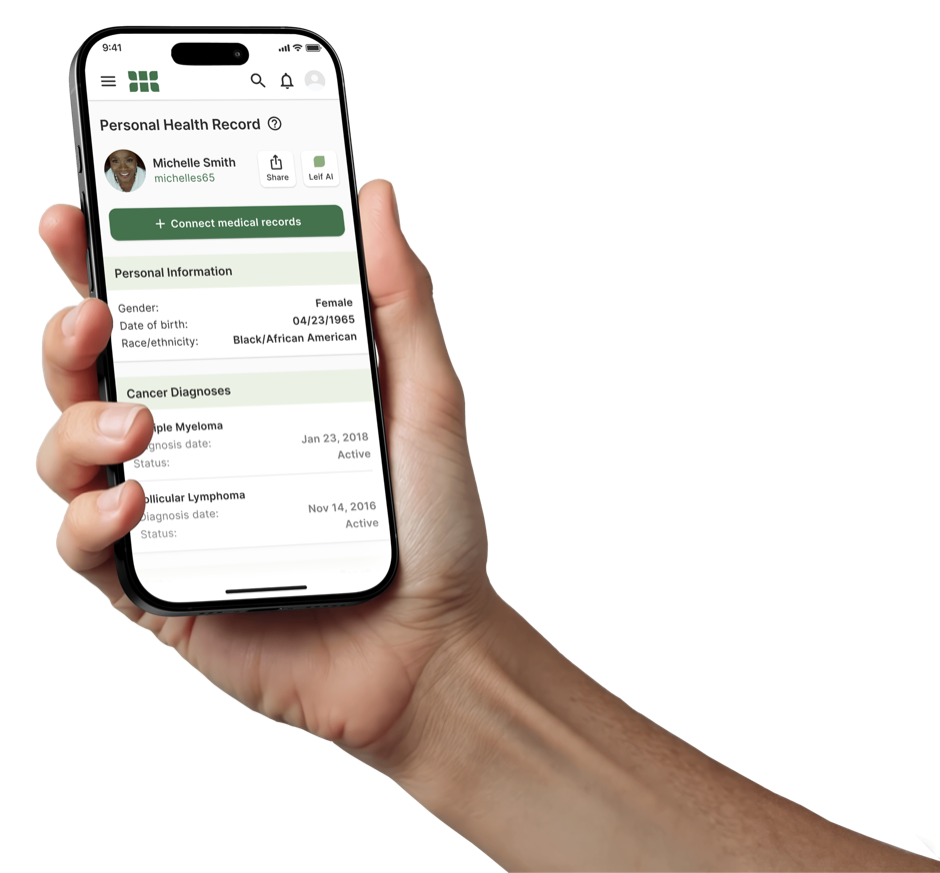
*Some features are not available for all cancers.
Trusted by research partners at













Own your story with a Personal Health Record
Today, your medical history is scattered across every care center you've been to — and the rest lives inside your own head. From before your diagnosis, through treatment, and every specialist in between, no single facility holds your whole story. You're left to stitch it together at a time you have the least capacity to do it.

One record you own and control
HealthTree's free Personal Health Record (PHR) is designed to support your decision-making with a more complete picture. With your permission, electronic health records from your various treatment centers are combined, validated and organized into one accurate, historical record that you own and control.
- Encrypted
- Secure
- Free for all cancer patients
The engine that powers deeper health insights
The more complete the record, the more clearly you can see your path forward — and the faster your experience fuels research and tomorrow's cure.
Track your labs over time
Every result plotted in easy-to-read charts.
You choose what to share
Your full record, or just what's relevant for a second opinion or an ER visit — with a QR code at a new treatment center.
Participate in changing how cancer research is done
Help researchers answer questions that drive faster progress.
Personalized support, built around you
Personalized cancer support starts with a complete picture of your health. When your Personal Health Record brings your full story together, HealthTree can provide insights and resources tailored to your specific diagnosis.*
*Some features are not available for all cancers.
Education and community just for you
You shape your own feed by subscribing to the topics that matter to you. HealthTree then tailors your feed with articles, videos, guides, podcasts, webinars and community posts on those topics.
Support matched to where you are
By building your Personal Health Record, you unlock context-specific support aligned with your diagnosis, treatment and where you are in your care. It allows HealthTree to show you:

Power the Cure: Research Accelerated by Real-World Data
Traditional cancer research can take a decade and millions of dollars to answer a single question, while the real-world information that could quickly answer thousands of questions is already sitting inside your health records.
Your Personal Health Record turns valuable information into validated, anonymous real-world data that HealthTree-approved researchers can access to drive faster progress. You can also add your voice directly — completing surveys and joining studies that explore questions your medical records alone cannot answer.
With your permission, you can do more than just receive care from the research system; you can help power it.


Your record stays yours
HealthTree is a non-profit organization with a mission to cure cancer. At HealthTree, your data remains secure in a Personal Health Record you own and control.
Free resources to help you navigate your cancer diagnosis
Every HealthTree tool is free.
Your Personal Health Record makes them yours.
Start exploring HealthTree today. Create a free account to access more tools and build your Personal Health Record to personalize your experience.
Without an account
- Resources feed: latest news about your cancer, educational videos, patient guides, podcasts and more
- Learn by topic: all the information about a topic in one place
- Specialist directory
- Explore all clinical trials and FDA-approved treatments for your cancer
With an account
- Find a coach
- Get HealthTree resources recommendations from a patient navigator
- Access to webinars
- Recently viewed: saves your browsing history inside HealthTree
- Participate in some surveys and studies to advance cures
- Ask questions to other patients and caregivers in the community
With your records connected
- Personalized treatments and trials for your cancer, with specific matches based on your medical records
- Participate in all surveys and studies to advance cures
- Personalized suggestions on educational resources based on your medical records
- Talk to a patient navigator to understand your labs, get ready for your next appointment and more