![[logo] HealthTree Foundation](https://static.healthtree.org/icons/icon_spinner.svg)
![[logo] HealthTree Foundation](https://static.healthtree.org/logo_icon_only.svg)
Coping with an AML Diagnosis: Steve and Pat's Perspective
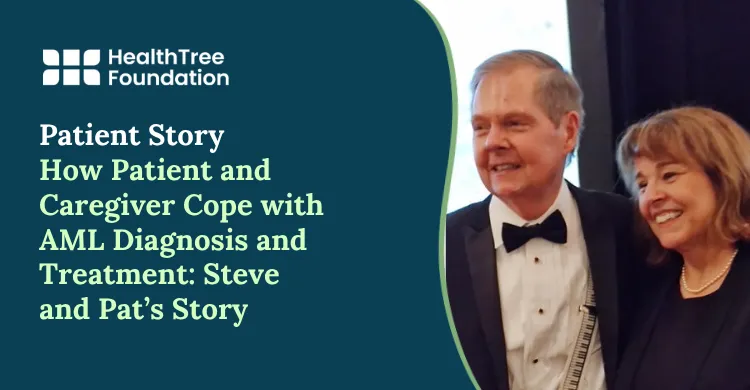


April 21st is AML World Awareness Day. Today we are sharing the story of Pat and Steve Hodges, who spoke to HealthTree Foundation about their experience after Steve's acute myeloid leukemia diagnosis.
Pat and Steve Hodges live in Durham, North Carolina, where they love having their coffee in the morning while Carolina sunshine streams in through the window and spending time with their children and grandchildren.
When Steve was diagnosed with acute myeloid leukemia (AML) 4 years ago, Pat drew on her own experiences with kidney cancer to be the best caregiver she could.
An early AML diagnosis
Fortunately for Steve, his AML was found very early, thanks to lab work he had done for a routine test. He was receiving treatment for rheumatoid and psoriatic arthritis, which he'd had for many years. The lead researcher who read the results called to inform Steve that his platelets were dangerously low and to contact his primary care physician immediately.
"Because of these labs, Steve's AML was detected early enough to consider treatment after his genetic results were in, a luxury many people do not have," Pat told HealthTree. Several adverse mutations were detected in his genetic testing.
Five lines of AML treatment
Like many people with AML, Steve has received multiple lines of therapy to control his AML. His first line of therapy was the standard 7+3 therapy, which is intensive chemotherapy for people newly diagnosed with AML. It generally consists of 7 days of continuous IV infusion of cytarabine and 3 days of an anthracycline given once a day.
After this line of treatment was completed, Steve still had a detectable RUNX1 mutation. This is a critical gene for the development of new blood cells, and its mutation is a high-risk marker in AML.
Steve's second line of therapy was FLAG-Ida. This is a chemotherapy regimen that treats AML after the initial treatment does not work. This is called refractory AML. FLAG-Ida is also used for people whose AML has come back after remission, which is called relapsed AML. FLAG-Ida is a combination of 4 medications:
- Fludarabine
- Cytarabine
- Idarubicin
- G-CSF
This treatment is used to destroy leukemia cells in the blood and bone marrow.
After FLAG-Ida, Steve had two rounds of consolidation therapy. This is treatment given after intensive treatment to destroy any cancer cells that are still in the body. After this therapy, Steve still had minimal residual disease (MRD). MRD is a sensitive test that can find small amounts of cancer cells in the body. He was given 2 cycles of azacitidine and venetoclax (Venclexta).
Finally, Steve received an allogeneic stem cell transplant where his damaged bone marrow was replaced with healthy bone marrow from a donor. It took 9 months, but Steve just celebrated his 3-year transplant anniversary.
Pat's AML caregiver story
Steve's wife, Pat, received her own cancer diagnosis of kidney cancer 17 years ago. Fortunately, it was caught early, and she was treated with surgery to remove half of her kidney. She did not need chemotherapy. Now, she became the caregiver for her husband as he went through his AML treatments.
Being a caregiver is a constant and often exhausting job. Pat found herself going through a grief process for the life and plans they had for the present and future. She felt very alone, especially during the first 45 days. She remained strong for Steve and, fortunately, had family and friends who offered support.
One way Pat coped was exercising every morning for an hour before she went to the hospital. She found this to be extremely helpful. "Caregiving is the hardest thing that I have ever done in my life," Pat said. "But it gets better as time goes on. It has given me experiences that have helped me to help others."
Pat's caregiving advice
Through her experience, Pat has learned a lot that can help other people who are becoming caregivers:
- Never, ever give up!
- Do your research.
- HealthTree's educational videos are outstanding and helpful.
- Learn how to cope with anxiety.
- Pray and ask your friends and family to pray.
- There are good days and bad days. Try to stay positive. This is hard to accomplish some days, but it is doable.
- Establish an easy avenue for getting information out to friends and family about your loved one's health. This could be an email thread or a private Facebook group.
"Life gets better," Pat said. "You learn to deal with the stress. It has been 4 years now. We are grateful that Steve is here. We appreciate every day. It is almost a miracle that Steve is still here. Stay positive. Stay strong."
Using HealthTree as a patient or caregiver
The first place that Pat looked for information after Steve's diagnosis was HealthTree. She found so much helpful information that was up-to-date and accurate. Both Pat and Steve became active on HealthTree and even became HealthTree coaches. They are grateful to give back and help others going through their same situation.
April 21st is AML World Awareness Day. Today we are sharing the story of Pat and Steve Hodges, who spoke to HealthTree Foundation about their experience after Steve's acute myeloid leukemia diagnosis.
Pat and Steve Hodges live in Durham, North Carolina, where they love having their coffee in the morning while Carolina sunshine streams in through the window and spending time with their children and grandchildren.
When Steve was diagnosed with acute myeloid leukemia (AML) 4 years ago, Pat drew on her own experiences with kidney cancer to be the best caregiver she could.
An early AML diagnosis
Fortunately for Steve, his AML was found very early, thanks to lab work he had done for a routine test. He was receiving treatment for rheumatoid and psoriatic arthritis, which he'd had for many years. The lead researcher who read the results called to inform Steve that his platelets were dangerously low and to contact his primary care physician immediately.
"Because of these labs, Steve's AML was detected early enough to consider treatment after his genetic results were in, a luxury many people do not have," Pat told HealthTree. Several adverse mutations were detected in his genetic testing.
Five lines of AML treatment
Like many people with AML, Steve has received multiple lines of therapy to control his AML. His first line of therapy was the standard 7+3 therapy, which is intensive chemotherapy for people newly diagnosed with AML. It generally consists of 7 days of continuous IV infusion of cytarabine and 3 days of an anthracycline given once a day.
After this line of treatment was completed, Steve still had a detectable RUNX1 mutation. This is a critical gene for the development of new blood cells, and its mutation is a high-risk marker in AML.
Steve's second line of therapy was FLAG-Ida. This is a chemotherapy regimen that treats AML after the initial treatment does not work. This is called refractory AML. FLAG-Ida is also used for people whose AML has come back after remission, which is called relapsed AML. FLAG-Ida is a combination of 4 medications:
- Fludarabine
- Cytarabine
- Idarubicin
- G-CSF
This treatment is used to destroy leukemia cells in the blood and bone marrow.
After FLAG-Ida, Steve had two rounds of consolidation therapy. This is treatment given after intensive treatment to destroy any cancer cells that are still in the body. After this therapy, Steve still had minimal residual disease (MRD). MRD is a sensitive test that can find small amounts of cancer cells in the body. He was given 2 cycles of azacitidine and venetoclax (Venclexta).
Finally, Steve received an allogeneic stem cell transplant where his damaged bone marrow was replaced with healthy bone marrow from a donor. It took 9 months, but Steve just celebrated his 3-year transplant anniversary.
Pat's AML caregiver story
Steve's wife, Pat, received her own cancer diagnosis of kidney cancer 17 years ago. Fortunately, it was caught early, and she was treated with surgery to remove half of her kidney. She did not need chemotherapy. Now, she became the caregiver for her husband as he went through his AML treatments.
Being a caregiver is a constant and often exhausting job. Pat found herself going through a grief process for the life and plans they had for the present and future. She felt very alone, especially during the first 45 days. She remained strong for Steve and, fortunately, had family and friends who offered support.
One way Pat coped was exercising every morning for an hour before she went to the hospital. She found this to be extremely helpful. "Caregiving is the hardest thing that I have ever done in my life," Pat said. "But it gets better as time goes on. It has given me experiences that have helped me to help others."
Pat's caregiving advice
Through her experience, Pat has learned a lot that can help other people who are becoming caregivers:
- Never, ever give up!
- Do your research.
- HealthTree's educational videos are outstanding and helpful.
- Learn how to cope with anxiety.
- Pray and ask your friends and family to pray.
- There are good days and bad days. Try to stay positive. This is hard to accomplish some days, but it is doable.
- Establish an easy avenue for getting information out to friends and family about your loved one's health. This could be an email thread or a private Facebook group.
"Life gets better," Pat said. "You learn to deal with the stress. It has been 4 years now. We are grateful that Steve is here. We appreciate every day. It is almost a miracle that Steve is still here. Stay positive. Stay strong."
Using HealthTree as a patient or caregiver
The first place that Pat looked for information after Steve's diagnosis was HealthTree. She found so much helpful information that was up-to-date and accurate. Both Pat and Steve became active on HealthTree and even became HealthTree coaches. They are grateful to give back and help others going through their same situation.

about the author
Lisa Foster
Lisa Foster is a mom of 3 daughters and 1 perfect grandchild, a puzzle lover, writer and HealthTree advocate. She believes in the mission of the foundation and the team that builds it forward. She calls Houston, Texas home.
More on Patient Stories



Trending Articles




Upcoming Events


Get the Latest Acute Myeloid Leukemia Updates, Delivered to You.
By subscribing to the HealthTree newsletter, you'll receive the latest research, treatment updates, and expert insights to help you navigate your health.
Together we care.
Together we cure.