![[logo] HealthTree Foundation](https://static.healthtree.org/icons/icon_spinner.svg)
![[logo] HealthTree Foundation](https://static.healthtree.org/logo_icon_only.svg)
ASH 2025 CAR T-Cell Therapy Updates: Moving Treatments to Earlier Lines of Care
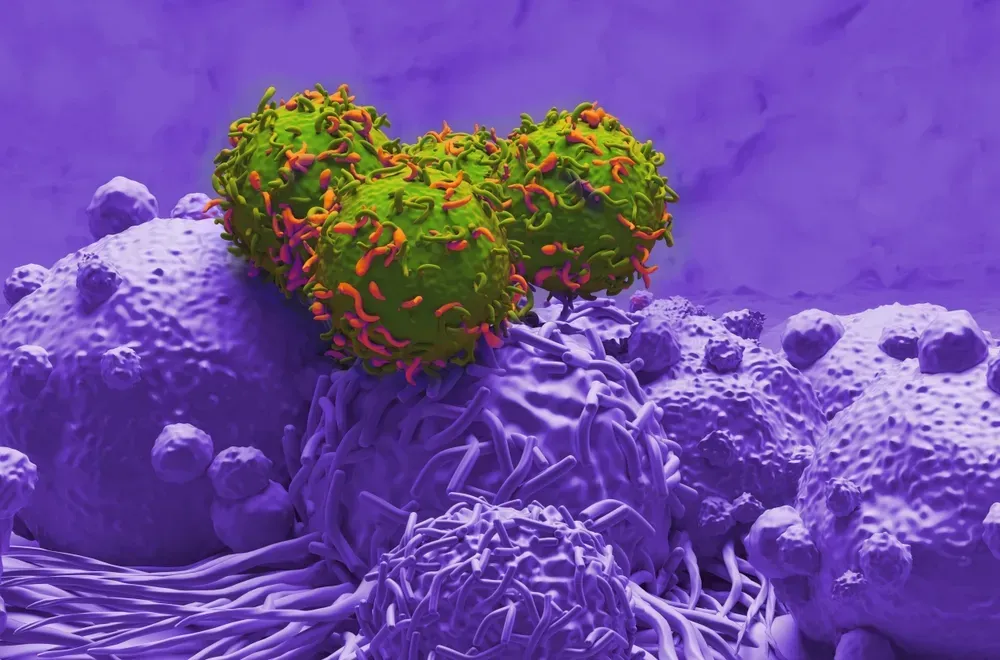


This year, at the American Society of Hematology (ASH) Annual Meeting, researchers presented on the evolving role of CAR T-cell therapy. While these therapies have typically been reserved for people who have tried multiple treatments, these new studies are evaluating their effectiveness earlier in the disease course and more efficient ways to treat complex cases.
These studies explore using CAR T-cell therapy for newly diagnosed multiple myeloma, aggressive plasma cell leukemia, and difficult-to-treat extramedullary disease.
Dual-target CAR-T for newly diagnosed patients
Researchers are currently testing GC012F/AZD0120, a therapy that modifies a patient's own T-cells to target two specific proteins on cancer cells: BCMA and CD19. This treatment utilizes a specialized manufacturing platform called FasTCAR-T, this enables next-day manufacturing.
Two phase 1 clinical trials are evaluating this therapy for patients with newly diagnosed multiple myeloma. The study includes both patients who are eligible for stem cell transplants and those who are not. Long-term data from 30 patients show high response rates following a single infusion of the therapy.
- Response rates: Every person in this group responded to the treatment, with 97% achieving a stringent complete response.
- Depth of response: All participants reached minimal residual disease (MRD) negativity, meaning no cancer cells were detected.
- Durability: At the 30-month mark, 88% of patients had not experienced disease progression, and 92% were still alive.
These results show that people with soft-tissue plasmacytomas (tumors outside the bone) had shorter progression-free survival compared to others. The safety profile was manageable, with low-grade cytokine release syndrome (CRS) reported in one-third of patients and no reported neurotoxicity.
Treating aggressive plasma cell leukemia without transplant
Primary plasma cell leukemia (PPCL) is an aggressive form of plasma cell cancer. It typically has poor outcomes, especially in people who can’t undergo a stem cell transplant. The phase 2 CAREMM-002 trial is investigating whether BCMA-directed CAR T-cell therapy can serve as an effective first-line treatment for this specific group.
In this study, participants received induction therapy followed by a single infusion of CAR T-cells. Early results from eight patients suggest that this approach may provide durable disease control.
- Response rates: All participants responded to the treatment, and 87.5% achieved a stringent complete response (sCR), which is the deepest level of remission.
- Status of remission: With a median follow-up of over 15 months, no relapses or deaths were reported among participants.
- Safety: The side effects were consistent with known CAR T-cell therapy risks. While cytokine release syndrome (CRS) occurred in nearly 63% of patients, all cases were low-grade, and there were no lasting signs of neurotoxicity.
These findings suggest that CAR T-cell therapy may become a viable option for transplant-ineligible patients with PPCL, although longer follow-up is necessary to fully understand its long-term benefits.
A multi-step approach for extramedullary disease (EMD)
Treating relapsed or refractory multiple myeloma becomes more challenging when the disease presents outside the bone marrow, extramedullary disease (EMD). These tumors often create an environment that suppresses the immune system, making single-agent therapies less effective.
To address this, researchers tested a strategy combining chemotherapy and low-dose radiation with two different types of CAR T-cells: one targeting BCMA and the other targeting GPRC5D. The goal of the initial chemotherapy and radiation was to reduce the tumor size before administering the CAR T-cells.
- Outcomes: In a small group of eight heavily pretreated patients, 87.5% responded to the therapy.
- Tumor reduction: Nearly all patients who responded saw a complete metabolic response in their extramedullary lesions.
- Survival: At the time of analysis (median follow-up, 8.5 months), all participants were alive.
The treatment was well-tolerated, with manageable side effects and a favorable CAR T-cell expansion in the body. This sequential approach may provide a new method for managing extramedullary disease more effectively.
These updates reveal new possibilities for using CAR T-cell therapies beyond their current indications. By targeting the disease earlier and addressing high-risk or complex presentations, outcomes can improve for a greater number of people. However, these studies need further research to be fully approved. Continued research and larger studies are required to confirm these findings and establish these treatments as standard care.
You can also participate in accelerating research!
HealthTree Foundation is a non-profit organization dedicated to finding a cure for blood cancers. Our content, programs, research, and HealthTree Cure Hub® platform are designed to empower the blood cancer community and advance cures.
This year, at the American Society of Hematology (ASH) Annual Meeting, researchers presented on the evolving role of CAR T-cell therapy. While these therapies have typically been reserved for people who have tried multiple treatments, these new studies are evaluating their effectiveness earlier in the disease course and more efficient ways to treat complex cases.
These studies explore using CAR T-cell therapy for newly diagnosed multiple myeloma, aggressive plasma cell leukemia, and difficult-to-treat extramedullary disease.
Dual-target CAR-T for newly diagnosed patients
Researchers are currently testing GC012F/AZD0120, a therapy that modifies a patient's own T-cells to target two specific proteins on cancer cells: BCMA and CD19. This treatment utilizes a specialized manufacturing platform called FasTCAR-T, this enables next-day manufacturing.
Two phase 1 clinical trials are evaluating this therapy for patients with newly diagnosed multiple myeloma. The study includes both patients who are eligible for stem cell transplants and those who are not. Long-term data from 30 patients show high response rates following a single infusion of the therapy.
- Response rates: Every person in this group responded to the treatment, with 97% achieving a stringent complete response.
- Depth of response: All participants reached minimal residual disease (MRD) negativity, meaning no cancer cells were detected.
- Durability: At the 30-month mark, 88% of patients had not experienced disease progression, and 92% were still alive.
These results show that people with soft-tissue plasmacytomas (tumors outside the bone) had shorter progression-free survival compared to others. The safety profile was manageable, with low-grade cytokine release syndrome (CRS) reported in one-third of patients and no reported neurotoxicity.
Treating aggressive plasma cell leukemia without transplant
Primary plasma cell leukemia (PPCL) is an aggressive form of plasma cell cancer. It typically has poor outcomes, especially in people who can’t undergo a stem cell transplant. The phase 2 CAREMM-002 trial is investigating whether BCMA-directed CAR T-cell therapy can serve as an effective first-line treatment for this specific group.
In this study, participants received induction therapy followed by a single infusion of CAR T-cells. Early results from eight patients suggest that this approach may provide durable disease control.
- Response rates: All participants responded to the treatment, and 87.5% achieved a stringent complete response (sCR), which is the deepest level of remission.
- Status of remission: With a median follow-up of over 15 months, no relapses or deaths were reported among participants.
- Safety: The side effects were consistent with known CAR T-cell therapy risks. While cytokine release syndrome (CRS) occurred in nearly 63% of patients, all cases were low-grade, and there were no lasting signs of neurotoxicity.
These findings suggest that CAR T-cell therapy may become a viable option for transplant-ineligible patients with PPCL, although longer follow-up is necessary to fully understand its long-term benefits.
A multi-step approach for extramedullary disease (EMD)
Treating relapsed or refractory multiple myeloma becomes more challenging when the disease presents outside the bone marrow, extramedullary disease (EMD). These tumors often create an environment that suppresses the immune system, making single-agent therapies less effective.
To address this, researchers tested a strategy combining chemotherapy and low-dose radiation with two different types of CAR T-cells: one targeting BCMA and the other targeting GPRC5D. The goal of the initial chemotherapy and radiation was to reduce the tumor size before administering the CAR T-cells.
- Outcomes: In a small group of eight heavily pretreated patients, 87.5% responded to the therapy.
- Tumor reduction: Nearly all patients who responded saw a complete metabolic response in their extramedullary lesions.
- Survival: At the time of analysis (median follow-up, 8.5 months), all participants were alive.
The treatment was well-tolerated, with manageable side effects and a favorable CAR T-cell expansion in the body. This sequential approach may provide a new method for managing extramedullary disease more effectively.
These updates reveal new possibilities for using CAR T-cell therapies beyond their current indications. By targeting the disease earlier and addressing high-risk or complex presentations, outcomes can improve for a greater number of people. However, these studies need further research to be fully approved. Continued research and larger studies are required to confirm these findings and establish these treatments as standard care.
You can also participate in accelerating research!
HealthTree Foundation is a non-profit organization dedicated to finding a cure for blood cancers. Our content, programs, research, and HealthTree Cure Hub® platform are designed to empower the blood cancer community and advance cures.

about the author
Jimena Vicencio
Jimena is an International Medical Graduate and a member of the HealthTree Writing team. Currently pursuing a bachelor's degree in journalism, she combines her medical background with a storyteller’s heart to make complex healthcare topics accessible to everyone. Driven by a deep belief that understanding health is a universal right, she is committed to translating scientific and medical knowledge into clear, compassionate language that empowers individuals to take control of their well-being.
More on Conferences




Trending Articles




Upcoming Events


Get the Latest Acute Myeloid Leukemia Updates, Delivered to You.
By subscribing to the HealthTree newsletter, you'll receive the latest research, treatment updates, and expert insights to help you navigate your health.
Together we care.
Together we cure.