![[logo] HealthTree Foundation](https://static.healthtree.org/icons/icon_spinner.svg)
![[logo] HealthTree Foundation](https://static.healthtree.org/logo_icon_only.svg)
Using Genetics to Eliminate Only MDS Cells with U2AF1 Mutations
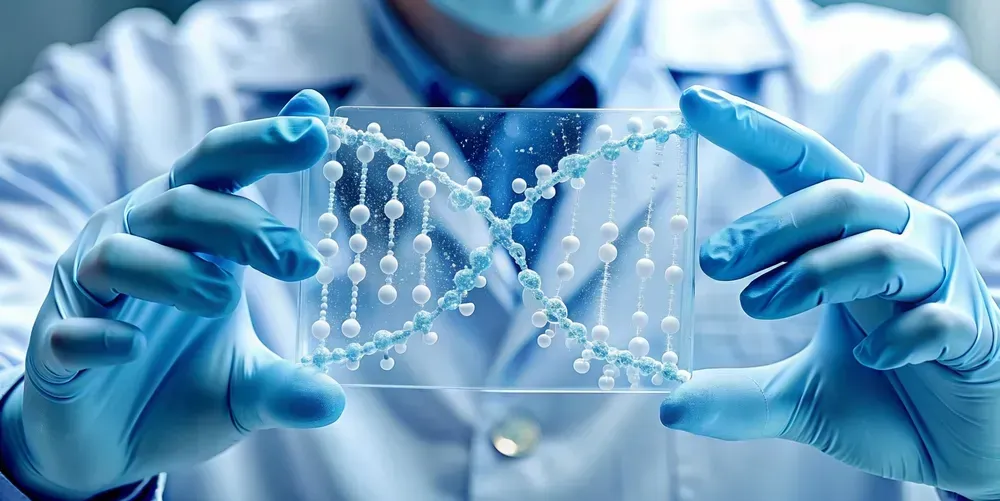


Recently, at the American Society of Hematology (ASH) Annual Meeting, researchers presented a new precision gene therapy approach for people with myelodysplastic syndromes (MDS) who have U2AF1 mutations.
This early research focuses on designing genetic “switches” that selectively eliminate cancer cells while sparing healthy ones.
What is U2AF1 and why does it matter in MDS?
U2AF1 is a gene involved in RNA splicing, the process cells use to correctly read genetic instructions. In MDS, mutations in splicing genes like U2AF1, SF3B1, and SRSF2 are common and can drive abnormal blood cell development.
Certain U2AF1 mutations are associated with higher-risk disease and shorter survival because these mutations change how RNA is processed and create potential weaknesses.
Finding a more specific therapy may eliminate side effects that result from other treatments that discard both healthy and cancerous cells
Current treatments for high-risk MDS often affect both cancerous and healthy cells. This can lead to side effects and limited long-term control.
The goal of this research is to create a therapy that:
- Detects only U2AF1-mutated cells
- Activates a treatment inside those cells
- Leaves normal cells unharmed
What are synthetic introns?
Introns are sections of RNA that are normally removed before a gene is turned into a protein. A synthetic intron is an engineered version designed to behave differently depending on whether a cell has a mutation.
In this study, synthetic introns are processed only in U2AF1-mutant cells. In normal cells, the same genetic message stays incomplete and inactive.
How does this approach kill only mutant cells?
The synthetic introns were inserted into a gene encoding HSV-TK. On its own, HSV-TK does nothing. But when the antiviral drug ganciclovir is given, HSV-TK converts it into a toxic substance that kills the affected cells.
To make this approach more precise, researchers:
- Shortened natural introns into smaller synthetic versions
- Used machine learning (SpliceAI) to predict how different designs would behave
- Screened over 12,000 intron variants to find those that best killed mutant cells while sparing normal ones
One optimized intron showed strong selectivity for U2AF1-mutant cells in lab models.
How could this therapy be delivered to patients?
Delivering genetic material to the right place is a major challenge. Researchers are testing lipid nanoparticles (LNPs), similar to those used in some vaccines.
Because RNA must reach the cell nucleus to be spliced, the team is also exploring DNA delivery systems that reduce inflammation and improve nuclear entry. These delivery methods are still being tested in early studies.
Why is this research important for patients?
This work represents a potential shift toward:
- Mutation-specific treatments
- Fewer side effects from therapy
- Personalized approaches for higher-risk MDS
While this research is still not approved to be tested in humans, it opens the door to future treatments that directly target the genetic drivers of disease rather than broadly suppressing the bone marrow.
A deeper understanding of MDS can turn into more effective therapies
Precision approaches like this are still in development, but they reflect a future where treatment decisions may be guided by your specific mutation profile.
Staying informed and engaged with emerging research empowers you to have more meaningful conversations with your care team and helps ensure that your treatment journey reflects both science and hope.
For more educational articles and free webinars, subscribe to our newsletter.
Recently, at the American Society of Hematology (ASH) Annual Meeting, researchers presented a new precision gene therapy approach for people with myelodysplastic syndromes (MDS) who have U2AF1 mutations.
This early research focuses on designing genetic “switches” that selectively eliminate cancer cells while sparing healthy ones.
What is U2AF1 and why does it matter in MDS?
U2AF1 is a gene involved in RNA splicing, the process cells use to correctly read genetic instructions. In MDS, mutations in splicing genes like U2AF1, SF3B1, and SRSF2 are common and can drive abnormal blood cell development.
Certain U2AF1 mutations are associated with higher-risk disease and shorter survival because these mutations change how RNA is processed and create potential weaknesses.
Finding a more specific therapy may eliminate side effects that result from other treatments that discard both healthy and cancerous cells
Current treatments for high-risk MDS often affect both cancerous and healthy cells. This can lead to side effects and limited long-term control.
The goal of this research is to create a therapy that:
- Detects only U2AF1-mutated cells
- Activates a treatment inside those cells
- Leaves normal cells unharmed
What are synthetic introns?
Introns are sections of RNA that are normally removed before a gene is turned into a protein. A synthetic intron is an engineered version designed to behave differently depending on whether a cell has a mutation.
In this study, synthetic introns are processed only in U2AF1-mutant cells. In normal cells, the same genetic message stays incomplete and inactive.
How does this approach kill only mutant cells?
The synthetic introns were inserted into a gene encoding HSV-TK. On its own, HSV-TK does nothing. But when the antiviral drug ganciclovir is given, HSV-TK converts it into a toxic substance that kills the affected cells.
To make this approach more precise, researchers:
- Shortened natural introns into smaller synthetic versions
- Used machine learning (SpliceAI) to predict how different designs would behave
- Screened over 12,000 intron variants to find those that best killed mutant cells while sparing normal ones
One optimized intron showed strong selectivity for U2AF1-mutant cells in lab models.
How could this therapy be delivered to patients?
Delivering genetic material to the right place is a major challenge. Researchers are testing lipid nanoparticles (LNPs), similar to those used in some vaccines.
Because RNA must reach the cell nucleus to be spliced, the team is also exploring DNA delivery systems that reduce inflammation and improve nuclear entry. These delivery methods are still being tested in early studies.
Why is this research important for patients?
This work represents a potential shift toward:
- Mutation-specific treatments
- Fewer side effects from therapy
- Personalized approaches for higher-risk MDS
While this research is still not approved to be tested in humans, it opens the door to future treatments that directly target the genetic drivers of disease rather than broadly suppressing the bone marrow.
A deeper understanding of MDS can turn into more effective therapies
Precision approaches like this are still in development, but they reflect a future where treatment decisions may be guided by your specific mutation profile.
Staying informed and engaged with emerging research empowers you to have more meaningful conversations with your care team and helps ensure that your treatment journey reflects both science and hope.
For more educational articles and free webinars, subscribe to our newsletter.

about the author
Jimena Vicencio
Jimena is an International Medical Graduate and a member of the HealthTree Writing team. Currently pursuing a bachelor's degree in journalism, she combines her medical background with a storyteller’s heart to make complex healthcare topics accessible to everyone. Driven by a deep belief that understanding health is a universal right, she is committed to translating scientific and medical knowledge into clear, compassionate language that empowers individuals to take control of their well-being.
More on Treatment Advances




Trending Articles




Get the Latest Myelofibrosis Updates, Delivered to You.
By subscribing to the HealthTree newsletter, you'll receive the latest research, treatment updates, and expert insights to help you navigate your health.
Together we care.
Together we cure.