![[logo] HealthTree Foundation](https://static.healthtree.org/icons/icon_spinner.svg)
![[logo] HealthTree Foundation](https://static.healthtree.org/logo_icon_only.svg)
Understanding Lung Cancer

Joining A Clinical Trial for Lung Cancer
Last updated and reviewed on May 16, 2026.
Joining a clinical trial is a big decision, but it is one that many patients consider when looking for the best possible care. A clinical trial is a carefully controlled research study where doctors test new ways to prevent, find, or treat diseases like lung cancer. In 2026, these trials are more advanced than ever, offering patients a chance to try treatments that are not yet available to the general public.
Clinical trials can test different things, such as:
-
New medications or combinations of medications
New surgery or radiation techniques
How well current treatments work for different groups of patients
Other approaches that may improve the quality of life
All patients who enroll in clinical trials are volunteers. All medications approved by the U.S. Food and Drug Administration (FDA) must go through clinical trials to measure how safe and effective they are.
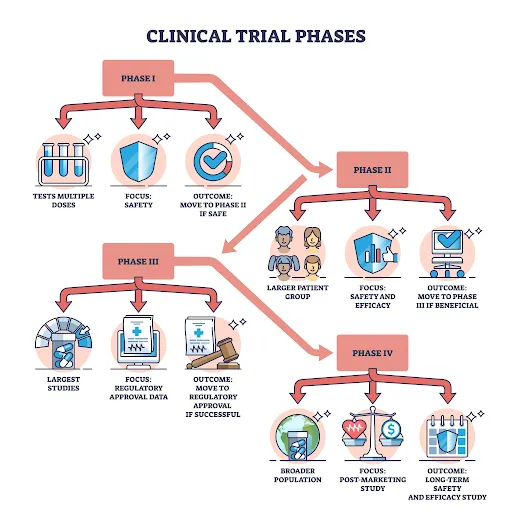
Clinical trials happen in stages called phases, and each phase answers different questions.
Phase I: Is it Safe? (Safety & Dosage)
The primary goal of Phase I is to make sure the treatment is not toxic to humans and to find the highest dose that can be given safely without causing severe side effects.
-
Participants: A very small group, typically 15 to 30 people.
-
Who joins: For most diseases, these are healthy volunteers. However, for serious illnesses like cancer, Phase I trials usually enroll patients who have already tried all standard treatments.
What happens: Doctors start by giving a very low dose of the drug to a few patients. If it is safe, they give a slightly higher dose to the next group. They closely monitor how the drug is processed by the body and look for side effects.
Phase II: Does it Work? (Efficacy & Side Effects)
Once a safe dosage is found, the treatment moves to Phase II. The main goal here is to see if the drug actually has a positive effect on the disease, while continuing to monitor safety.
-
Participants: A larger group, typically 25 to 100+ people.
-
Who joins: Patients who actually have the specific disease or condition the drug is designed to treat.
What happens: Patients receive the safe dose determined in Phase I. Doctors look for clinical markers—for example, in a cancer trial, they measure whether the tumor shrinks. If the drug shows promise and the side effects are acceptable, it moves forward.
Phase III: Is it Better Than What We Have? (Comparison & Confirmation)
Phase III trials are the massive, definitive studies required before a drug can be approved for the general public. The goal is to prove the new treatment is better, or at least as good as, the current "Standard of Care" (the treatment doctors currently use).
-
Participants: Hundreds to thousands of people (100 to 3,000+).
-
Who joins: A diverse group of patients with the targeted condition, often across multiple hospitals or countries.
What happens: These are often randomized, double-blind studies. Patients are randomly assigned to one of two groups: one gets the new treatment, and the other gets the current standard treatment. Neither the patients nor the doctors know who is getting which drug. This prevents bias and proves whether the new drug genuinely improves survival or quality of life.
Note on Placebos: In life-threatening diseases like cancer, patients are never given a placebo (sugar pill) if a working standard treatment exists. They will always receive at least the current standard of care.
Phase IV: What are the Long-Term Effects? (Post-Market Surveillance)
Phase IV happens after the FDA has officially approved the drug and it is available on the market for doctors to prescribe.
-
Participants: Thousands to millions of patients in the real world.
What happens: Once a drug is used by a massive, diverse population over several years, rare or long-term side effects might appear that didn't show up in the smaller trial groups. Phase IV continuously tracks this real-world data to ensure the drug remains safe for the public over time.
Before you can join a clinical trial, you have to meet certain rules called eligibility criteria. The rules may be about age, cancer type and stage, treatment history, or general health. They ensure that participants are alike in specific ways and that the trial is as safe as possible for the participants. This means that not everyone will qualify for every trial.
|
NOTE: One common concern people have is the use of placebos, which are inactive treatments that contain no medicine. Placebos are never used alone in cancer clinical trials. It is common to receive a standard treatment or a new drug with a standard treatment. Even if you are in the group that does not receive the new drug being tested, you will still receive the standard treatment that doctors already know works. |
HealthTree Foundations offers the personalized Clinical Trial Finder. This tool matches you based on your diagnosis with open and enrolling clinical trials. Learn more.
What Are the Reasons to Join a Clinical Trial?
There are several strong reasons why someone with lung cancer might choose to join a clinical trial.
-
The most personal reason is the chance to access a treatment that is not yet available to the public. Patients reported participating in clinical trials because their doctors informed and encouraged them, they had no other treatment options if they wanted to live longer, or they wanted to help future patients with cancer. For some patients, a clinical trial may offer access to a drug or combination of drugs that could not be obtained any other way. Since 2024, the non-small cell lung cancer landscape has undergone a transformative shift, driven by 11 FDA approvals. Recent advances in molecular profiling, targeted therapies, and immunotherapies have revolutionized management, ushering in an era of personalized treatment with improved patient outcomes. Many of these treatments first became available through clinical trials before they were approved for general use.
-
A second reason to consider joining a trial is the quality of care and monitoring that comes with it. Patients in clinical trials are often seen more frequently by their care team and receive more detailed testing and follow-up than patients receiving standard treatment alone. Clinical trials provide an essential link between scientific discovery and clinical practice. These trials are crucial to the translation of new knowledge into tangible benefits for patients, and the knowledge gained in a clinical trial can also inform and guide further research into the biology of the disease. Being in a trial means that your health is being watched very closely by a dedicated research team whose entire focus is on your well-being and your care.
A third reason is cost. Many people do not realize that joining a clinical trial can reduce out-of-pocket costs for some treatments. There is no fee to enroll in a clinical trial. The study sponsor pays for research-related costs, including the study drug. But you may need to pay for other services, like transportation or childcare, due to extra appointments. While the trial drug itself is generally provided at no cost to you, it is important to check with your insurance provider and the research team about what other costs may or may not be covered. Some trials also provide help with transportation and other expenses.
A fourth reason, one that many patients find deeply meaningful, is the opportunity to help other people with lung cancer in the future. Clinical trials are very important. They help doctors learn about cancer and develop better treatments that can help you and other people in the future. Every treatment that doctors use today, including the immunotherapy drugs and targeted therapies that are giving lung cancer patients more time and better quality of life, became available because of patients who volunteered for clinical trials in the past. By joining a trial, you become part of that progress.
Finally, it is worth knowing that participation in clinical trials is still much lower than it could be, which means that many promising treatments take longer to reach patients than they should. It has been repeatedly estimated that less than 5% of adult cancer patients enroll in cancer clinical trials, even though 70% of Americans are estimated to be inclined or very willing to participate in clinical trials. The gap between the number of people who are willing to join trials and those who actually do is largely explained by a lack of information. If you are curious about clinical trials, the best first step is a conversation with your oncologist. You can also search for trials at any time by visiting ClinicalTrials.gov, the official U.S. government database of all currently active research studies.
Currently enrolling clinical trials for Lung Cancer
|
What’s Next: The next page in this guide is Coping with Lung Cancer. If you would like to read another page in this guide, return to the Lung Cancer 101 Guides page and choose another topic. |
Joining A Clinical Trial for Lung Cancer
Last updated and reviewed on May 16, 2026.
Joining a clinical trial is a big decision, but it is one that many patients consider when looking for the best possible care. A clinical trial is a carefully controlled research study where doctors test new ways to prevent, find, or treat diseases like lung cancer. In 2026, these trials are more advanced than ever, offering patients a chance to try treatments that are not yet available to the general public.
Clinical trials can test different things, such as:
-
New medications or combinations of medications
-
New surgery or radiation techniques
-
How well current treatments work for different groups of patients
-
Other approaches that may improve the quality of life
All patients who enroll in clinical trials are volunteers. All medications approved by the U.S. Food and Drug Administration (FDA) must go through clinical trials to measure how safe and effective they are.
Clinical trials happen in stages called phases, and each phase answers different questions.
Phase I: Is it Safe? (Safety & Dosage)
The primary goal of Phase I is to make sure the treatment is not toxic to humans and to find the highest dose that can be given safely without causing severe side effects.
-
Participants: A very small group, typically 15 to 30 people.
-
Who joins: For most diseases, these are healthy volunteers. However, for serious illnesses like cancer, Phase I trials usually enroll patients who have already tried all standard treatments.
-
What happens: Doctors start by giving a very low dose of the drug to a few patients. If it is safe, they give a slightly higher dose to the next group. They closely monitor how the drug is processed by the body and look for side effects.
Phase II: Does it Work? (Efficacy & Side Effects)
Once a safe dosage is found, the treatment moves to Phase II. The main goal here is to see if the drug actually has a positive effect on the disease, while continuing to monitor safety.
-
Participants: A larger group, typically 25 to 100+ people.
-
Who joins: Patients who actually have the specific disease or condition the drug is designed to treat.
-
What happens: Patients receive the safe dose determined in Phase I. Doctors look for clinical markers—for example, in a cancer trial, they measure whether the tumor shrinks. If the drug shows promise and the side effects are acceptable, it moves forward.
Phase III: Is it Better Than What We Have? (Comparison & Confirmation)
Phase III trials are the massive, definitive studies required before a drug can be approved for the general public. The goal is to prove the new treatment is better, or at least as good as, the current "Standard of Care" (the treatment doctors currently use).
-
Participants: Hundreds to thousands of people (100 to 3,000+).
-
Who joins: A diverse group of patients with the targeted condition, often across multiple hospitals or countries.
-
What happens: These are often randomized, double-blind studies. Patients are randomly assigned to one of two groups: one gets the new treatment, and the other gets the current standard treatment. Neither the patients nor the doctors know who is getting which drug. This prevents bias and proves whether the new drug genuinely improves survival or quality of life.
Note on Placebos: In life-threatening diseases like cancer, patients are never given a placebo (sugar pill) if a working standard treatment exists. They will always receive at least the current standard of care.
Phase IV: What are the Long-Term Effects? (Post-Market Surveillance)
Phase IV happens after the FDA has officially approved the drug and it is available on the market for doctors to prescribe.
-
Participants: Thousands to millions of patients in the real world.
-
What happens: Once a drug is used by a massive, diverse population over several years, rare or long-term side effects might appear that didn't show up in the smaller trial groups. Phase IV continuously tracks this real-world data to ensure the drug remains safe for the public over time.
Before you can join a clinical trial, you have to meet certain rules called eligibility criteria. The rules may be about age, cancer type and stage, treatment history, or general health. They ensure that participants are alike in specific ways and that the trial is as safe as possible for the participants. This means that not everyone will qualify for every trial.
|
NOTE: One common concern people have is the use of placebos, which are inactive treatments that contain no medicine. Placebos are never used alone in cancer clinical trials. It is common to receive a standard treatment or a new drug with a standard treatment. Even if you are in the group that does not receive the new drug being tested, you will still receive the standard treatment that doctors already know works. HealthTree Foundations offers the personalized Clinical Trial Finder. This tool matches you based on your diagnosis with open and enrolling clinical trials. Learn more. |
What Are the Reasons to Join a Clinical Trial?
There are several strong reasons why someone with lung cancer might choose to join a clinical trial.
-
The most personal reason is the chance to access a treatment that is not yet available to the public. Patients reported participating in clinical trials because their doctors informed and encouraged them, they had no other treatment options if they wanted to live longer, or they wanted to help future patients with cancer. For some patients, a clinical trial may offer access to a drug or combination of drugs that could not be obtained any other way. Since 2024, the non-small cell lung cancer landscape has undergone a transformative shift, driven by 11 FDA approvals. Recent advances in molecular profiling, targeted therapies, and immunotherapies have revolutionized management, ushering in an era of personalized treatment with improved patient outcomes. Many of these treatments first became available through clinical trials before they were approved for general use.
-
A second reason to consider joining a trial is the quality of care and monitoring that comes with it. Patients in clinical trials are often seen more frequently by their care team and receive more detailed testing and follow-up than patients receiving standard treatment alone. Clinical trials provide an essential link between scientific discovery and clinical practice. These trials are crucial to the translation of new knowledge into tangible benefits for patients, and the knowledge gained in a clinical trial can also inform and guide further research into the biology of the disease. Being in a trial means that your health is being watched very closely by a dedicated research team whose entire focus is on your well-being and your care.
-
A third reason is cost. Many people do not realize that joining a clinical trial can reduce out-of-pocket costs for some treatments. There is no fee to enroll in a clinical trial. The study sponsor pays for research-related costs, including the study drug. But you may need to pay for other services, like transportation or childcare, due to extra appointments. While the trial drug itself is generally provided at no cost to you, it is important to check with your insurance provider and the research team about what other costs may or may not be covered. Some trials also provide help with transportation and other expenses.
-
A fourth reason, one that many patients find deeply meaningful, is the opportunity to help other people with lung cancer in the future. Clinical trials are very important. They help doctors learn about cancer and develop better treatments that can help you and other people in the future. Every treatment that doctors use today, including the immunotherapy drugs and targeted therapies that are giving lung cancer patients more time and better quality of life, became available because of patients who volunteered for clinical trials in the past. By joining a trial, you become part of that progress.
-
Finally, it is worth knowing that participation in clinical trials is still much lower than it could be, which means that many promising treatments take longer to reach patients than they should. It has been repeatedly estimated that less than 5% of adult cancer patients enroll in cancer clinical trials, even though 70% of Americans are estimated to be inclined or very willing to participate in clinical trials. The gap between the number of people who are willing to join trials and those who actually do is largely explained by a lack of information. If you are curious about clinical trials, the best first step is a conversation with your oncologist. You can also search for trials at any time by visiting ClinicalTrials.gov, the official U.S. government database of all currently active research studies.
Currently enrolling clinical trials for Lung Cancer
|
What’s Next: The next page in this guide is Coping with Lung Cancer. If you would like to read another page in this guide, return to the Lung Cancer 101 Guides page and choose another topic. |

Get the Latest Lung Cancer Updates, Delivered to You.
By subscribing to the HealthTree newsletter, you'll receive the latest research, treatment updates, and expert insights to help you navigate your health.
Together we care.
Together we cure.