![[logo] HealthTree Foundation](https://static.healthtree.org/icons/icon_spinner.svg)
![[logo] HealthTree Foundation](https://static.healthtree.org/logo_icon_only.svg)
Crucial Lab Tests For Chronic Kidney Disease: Early Detection & Monitoring


Understanding Chronic Kidney Disease (CKD)
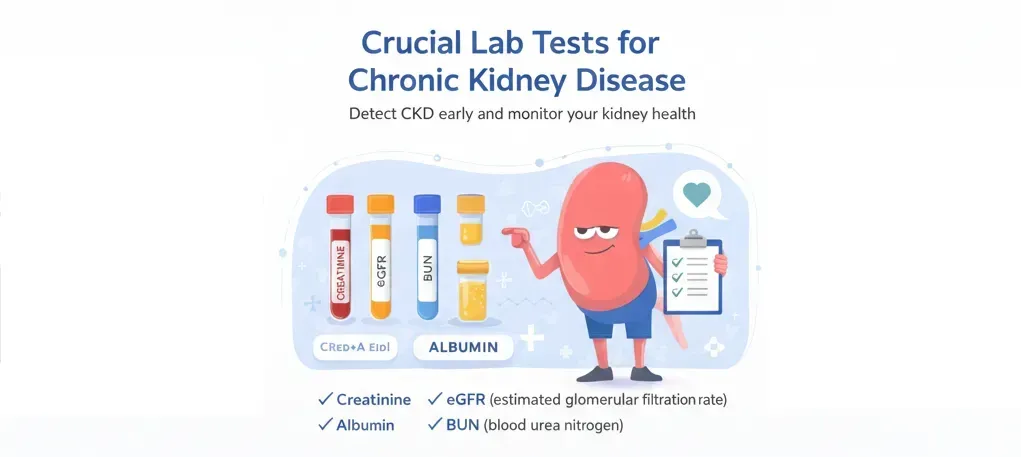
Chronic kidney disease (CKD) is a progressive condition where the kidneys gradually lose their ability to filter blood effectively. Early detection is crucial because symptoms often don’t appear until the disease is advanced. Lab tests for CKD are essential tools for monitoring kidney health and guiding treatment decisions.
Key Blood Tests to Monitor Kidney Function
There is a range of values that provide information about whether the kidneys are functioning properly or are in danger of being damaged. Here is a breakdown of the tests to monitor:
Creatinine: Measuring Kidney Filtering Ability
As muscles use energy, creatine is converted into creatinine, which is released into the bloodstream. The kidneys are responsible for filtering out creatinine and other waste products from the blood.
A blood test to measure the creatinine levels is usually a quality marker of kidney function. Elevated creatinine levels can indicate that the kidneys are not filtering properly. Creatinine levels only rise when kidney function has already declined by almost 50%.
eGFR: Estimating Your Kidney Function
GFR (glomerular filtration rate) refers to how well the kidneys filter blood.
-
This is a high-quality test to assess kidney function, but it is a difficult test to perform (requires multiple blood draws).
eGFR (estimated GFR) is an estimation of the filtration rate based on blood tests and other factors (such as creatinine levels, age, sex, and race).
-
This is a practical and widely used test to estimate kidney function.
-
It can be calculated from a single blood test, which is easier to perform than a GFR test.
-
It is important to remember this test is an estimation, not a specific measurement.
-
eGFR is used to measure kidney disease.
Albumin: Detecting Protein in Your Blood
This is a protein produced in the liver and is the most abundant protein in the blood.
-
Albumin in the urine is an indication of kidney disease.
-
Albumin in the urine is a key factor of chronic kidney disease (CKD) and is a factor for deciding CKD stages and progression.
-
This can also be a sign of poorly controlled diabetes.
“Both the eGFR and the albumin level help doctors to detect chronic kidney disease and monitor its progression. If the eGFR is below 60 millilitres per minute, this is referred to as impaired kidney function. A GFR of 60 ml/min corresponds to a kidney function of approximately 60%.”
BUN: Understanding Waste Levels in Your Blood
Urea nitrogen is a waste product formed when the body breaks down protein. The kidneys are responsible for removing urea from the blood.
-
When kidney function is impaired, they can not filter urea efficiently. BUN levels then increase in the blood.
-
A BUN test can help doctors see how well the kidneys are functioning and monitor the effectiveness of any kidney treatments.
Urine Tests for Detecting Kidney Damage
Urinalysis: Detecting Early Signs of Damage or Infection
A urinalysis can detect any abnormalities like protein, blood, or bacteria in the urine. This can indicate kidney damage or infection.
24-Hour Urine Collection: Accurate Measurement of Kidney Health
A 24-hour urine collection allows for a more direct measurement of protein, creatinine, and other substances in the urine.
Conclusion: The Importance of Regular Testing
Lab tests are crucial for monitoring and diagnosing kidney disease. They provide insights into kidney function, detect early signs of damage, and help design treatment plans. Many people don’t experience symptoms of kidney disease until it's in advanced stages. Lab tests are essential for detecting problems early, before significant damage occurs.
Understanding Chronic Kidney Disease (CKD)
Chronic kidney disease (CKD) is a progressive condition where the kidneys gradually lose their ability to filter blood effectively. Early detection is crucial because symptoms often don’t appear until the disease is advanced. Lab tests for CKD are essential tools for monitoring kidney health and guiding treatment decisions.
Key Blood Tests to Monitor Kidney Function
There is a range of values that provide information about whether the kidneys are functioning properly or are in danger of being damaged. Here is a breakdown of the tests to monitor:
Creatinine: Measuring Kidney Filtering Ability
As muscles use energy, creatine is converted into creatinine, which is released into the bloodstream. The kidneys are responsible for filtering out creatinine and other waste products from the blood.
A blood test to measure the creatinine levels is usually a quality marker of kidney function. Elevated creatinine levels can indicate that the kidneys are not filtering properly. Creatinine levels only rise when kidney function has already declined by almost 50%.
eGFR: Estimating Your Kidney Function
GFR (glomerular filtration rate) refers to how well the kidneys filter blood.
-
This is a high-quality test to assess kidney function, but it is a difficult test to perform (requires multiple blood draws).
eGFR (estimated GFR) is an estimation of the filtration rate based on blood tests and other factors (such as creatinine levels, age, sex, and race).
-
This is a practical and widely used test to estimate kidney function.
-
It can be calculated from a single blood test, which is easier to perform than a GFR test.
-
It is important to remember this test is an estimation, not a specific measurement.
-
eGFR is used to measure kidney disease.
Albumin: Detecting Protein in Your Blood
This is a protein produced in the liver and is the most abundant protein in the blood.
-
Albumin in the urine is an indication of kidney disease.
-
Albumin in the urine is a key factor of chronic kidney disease (CKD) and is a factor for deciding CKD stages and progression.
-
This can also be a sign of poorly controlled diabetes.
“Both the eGFR and the albumin level help doctors to detect chronic kidney disease and monitor its progression. If the eGFR is below 60 millilitres per minute, this is referred to as impaired kidney function. A GFR of 60 ml/min corresponds to a kidney function of approximately 60%.”
BUN: Understanding Waste Levels in Your Blood
Urea nitrogen is a waste product formed when the body breaks down protein. The kidneys are responsible for removing urea from the blood.
-
When kidney function is impaired, they can not filter urea efficiently. BUN levels then increase in the blood.
-
A BUN test can help doctors see how well the kidneys are functioning and monitor the effectiveness of any kidney treatments.
Urine Tests for Detecting Kidney Damage
Urinalysis: Detecting Early Signs of Damage or Infection
A urinalysis can detect any abnormalities like protein, blood, or bacteria in the urine. This can indicate kidney damage or infection.
24-Hour Urine Collection: Accurate Measurement of Kidney Health
A 24-hour urine collection allows for a more direct measurement of protein, creatinine, and other substances in the urine.
Conclusion: The Importance of Regular Testing
Lab tests are crucial for monitoring and diagnosing kidney disease. They provide insights into kidney function, detect early signs of damage, and help design treatment plans. Many people don’t experience symptoms of kidney disease until it's in advanced stages. Lab tests are essential for detecting problems early, before significant damage occurs.

about the author
Lisa Foster
Lisa Foster is a mom of 3 daughters and 1 perfect grandchild, a puzzle lover, writer and HealthTree advocate. She believes in the mission of the foundation and the team that builds it forward. She calls Houston, Texas home.
More on Core Education


Get the Latest Kidney Disease Updates, Delivered to You.
By subscribing to the HealthTree newsletter, you'll receive the latest research, treatment updates, and expert insights to help you navigate your health.
Together we care.
Together we cure.
3x Faster.