![[logo] HealthTree Foundation](https://static.healthtree.org/icons/icon_spinner.svg)
![[logo] HealthTree Foundation](https://static.healthtree.org/logo_icon_only.svg)
Understanding Kidney Cancer

Joining a Clinical Trial for Kidney Cancer
Last updated and reviewed on June 13, 2026.
If you have been diagnosed with kidney cancer, your doctor may mention clinical trials as a possible option. For some patients, a clinical trial offers access to the most promising new treatments before they are widely available. For others, it is a way to give back, helping researchers learn how to treat kidney cancer better for future patients. This guide explains what clinical trials are, how they work, and why they may be worth considering.
What Is a Clinical Trial?
A clinical trial is a carefully designed research study that tests whether a new treatment, drug, medical device, or approach to care is safe and effective in people. Before any new cancer treatment can be approved by the U.S. Food and Drug Administration (FDA), it must be tested in clinical trials to prove it works and that its benefits outweigh its risks.
Clinical trials follow strict rules set by the National Institutes of Health (NIH), the FDA, and independent ethics review boards (called Institutional Review Boards, or IRBs). These rules are in place to protect participants and ensure the research is conducted responsibly.
What Are the Reasons to Join a Clinical Trial?
Access to new and potentially more effective treatments. Clinical trials offer access to treatments that are not yet available to the general public. For people with advanced or treatment-resistant kidney cancer, a trial may offer a new option when standard treatments are no longer working. Some of the most effective kidney cancer treatments used today, including the immunotherapy combinations that have transformed the field, were first tested in clinical trials.
Closer monitoring and expert care. Participants in clinical trials are typically monitored more closely than patients in standard care, with more frequent tests, imaging, and follow-up. You are cared for by specialists who have deep expertise in kidney cancer and access to the latest research.
Contributing to progress. By joining a trial, you help researchers learn what works and what does not. Your participation could directly benefit future patients with kidney cancer.
Possible cost savings. The experimental treatment in a clinical trial is often provided at no cost to participants. Other costs, such as doctor visits, lab tests, and imaging related to the trial, may also be covered by the trial sponsor. However, costs related to standard care may still be billed to your insurance. Always ask the trial team about costs before enrolling.
Trials are not just for last resort. A common misconception is that clinical trials are only for patients who have run out of other options. In fact, trials are available and sometimes recommended at many stages of disease, including as first-line treatment for newly diagnosed patients. Ask your doctor early whether a trial might be a good option for you.
How Do Clinical Trials Work?
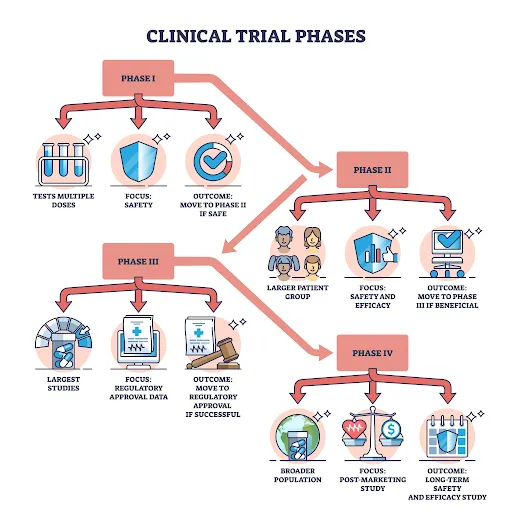
Clinical trials are conducted in phases:
- Phase I: Tests a new treatment for the first time in a small number of people to check safety and find the right dose. Usually, for patients who have already tried standard treatments.
- Phase II: Tests whether the treatment works for a specific cancer type in a larger group. Looks at effectiveness as well as safety.
- Phase III: Compares the new treatment to the current standard treatment in a large number of patients. Often, randomized patients are assigned by chance to receive either the new treatment or the standard one. This is how researchers determine whether a new treatment is truly better.
- Phase IV: Studies continue after a drug is approved to gather more long-term data on safety and effectiveness in a broader population.
Before joining a trial, you will go through an informed consent process. The research team will explain the trial's purpose, procedures, potential risks, and potential benefits in detail. You will be given written information to review and asked to sign a consent form. Signing does not permanently commit you — you can leave the trial at any time without penalty.
How to Find Kidney Cancer Clinical Trials
Several reliable sources list open clinical trials:
- ClinicalTrials.gov (maintained by the NIH): Search "kidney cancer" or "renal cell carcinoma" to find trials near you. https://clinicaltrials.gov
- HealthTree Clinical Trial Finder: HealthTree's tool helps match you with trials relevant to your specific diagnosis and treatment history.https://healthtree.org/kidney-disease/curehub/private/clinical-trials/list?primaryPurpose=Treatment&country=United+States
- National Cancer Institute: https://www.cancer.gov/about-cancer/treatment/clinical-trials/search
- Your doctor or cancer center: Kidney cancer specialists and academic medical centers are often connected to active trials. Ask your team what trials you may qualify for.
When searching, you can filter by cancer type, stage, location, and whether you have received prior treatments. You can also look for trials at institutions you are willing to travel to; some trials offer travel assistance.
What Questions Should I Ask About a Clinical Trial?
Before deciding to join a trial, ask the research team:
- What is the purpose of this trial, and what phase is it in?
- What treatments will I receive, and how are they given?
- What are the possible risks, side effects, and benefits?
- Is there a chance I will receive a placebo (inactive treatment) instead of the experimental drug?
- How does this trial compare to the standard treatment?
- How often will I need to come in for tests or visits?
- What costs are covered by the trial, and what will I have to pay out of pocket?
- Can I continue to see my regular doctors while I am in the trial?
- What happens if the treatment harms me or does not help me?
- Can I leave the trial if I change my mind?
Joining a clinical trial is a personal decision, and no one should feel pressured. But for many kidney cancer patients — particularly those with advanced disease or limited options — a trial can provide a real opportunity to access the most cutting-edge therapies available anywhere in the world.
|
What’s Next: The next page in this guide is Coping with Kidney Cancer. If you would like to read another page in this guide, return to the Kidney Cancere 101 Guides page or choose another topic. |
Sources:
- National Cancer Institute. Understanding Clinical Trials. https://www.cancer.gov/about-cancer/treatment/clinical-trials/what-are-trials
- American Cancer Society. What Are Clinical Trials? https://www.cancer.org/cancer/managing-cancer/making-treatment-decisions/clinical-trials/what-you-need-to-know.html
- National Institutes of Health. ClinicalTrials.gov. https://clinicaltrials.gov
- Motzer RJ, et al. Nivolumab plus Ipilimumab versus Sunitinib in Advanced Renal-Cell Carcinoma. New England Journal of Medicine. 2018;378:1277–1290.
- Rini BI, et al. Pembrolizumab plus Axitinib versus Sunitinib for Advanced Renal-Cell Carcinoma. New England Journal of Medicine. 2019;380:1116–1127.
Joining a Clinical Trial for Kidney Cancer
Last updated and reviewed on June 13, 2026.
If you have been diagnosed with kidney cancer, your doctor may mention clinical trials as a possible option. For some patients, a clinical trial offers access to the most promising new treatments before they are widely available. For others, it is a way to give back, helping researchers learn how to treat kidney cancer better for future patients. This guide explains what clinical trials are, how they work, and why they may be worth considering.
What Is a Clinical Trial?
A clinical trial is a carefully designed research study that tests whether a new treatment, drug, medical device, or approach to care is safe and effective in people. Before any new cancer treatment can be approved by the U.S. Food and Drug Administration (FDA), it must be tested in clinical trials to prove it works and that its benefits outweigh its risks.
Clinical trials follow strict rules set by the National Institutes of Health (NIH), the FDA, and independent ethics review boards (called Institutional Review Boards, or IRBs). These rules are in place to protect participants and ensure the research is conducted responsibly.
What Are the Reasons to Join a Clinical Trial?
Access to new and potentially more effective treatments. Clinical trials offer access to treatments that are not yet available to the general public. For people with advanced or treatment-resistant kidney cancer, a trial may offer a new option when standard treatments are no longer working. Some of the most effective kidney cancer treatments used today, including the immunotherapy combinations that have transformed the field, were first tested in clinical trials.
Closer monitoring and expert care. Participants in clinical trials are typically monitored more closely than patients in standard care, with more frequent tests, imaging, and follow-up. You are cared for by specialists who have deep expertise in kidney cancer and access to the latest research.
Contributing to progress. By joining a trial, you help researchers learn what works and what does not. Your participation could directly benefit future patients with kidney cancer.
Possible cost savings. The experimental treatment in a clinical trial is often provided at no cost to participants. Other costs, such as doctor visits, lab tests, and imaging related to the trial, may also be covered by the trial sponsor. However, costs related to standard care may still be billed to your insurance. Always ask the trial team about costs before enrolling.
Trials are not just for last resort. A common misconception is that clinical trials are only for patients who have run out of other options. In fact, trials are available and sometimes recommended at many stages of disease, including as first-line treatment for newly diagnosed patients. Ask your doctor early whether a trial might be a good option for you.
How Do Clinical Trials Work?
Clinical trials are conducted in phases:
- Phase I: Tests a new treatment for the first time in a small number of people to check safety and find the right dose. Usually, for patients who have already tried standard treatments.
- Phase II: Tests whether the treatment works for a specific cancer type in a larger group. Looks at effectiveness as well as safety.
- Phase III: Compares the new treatment to the current standard treatment in a large number of patients. Often, randomized patients are assigned by chance to receive either the new treatment or the standard one. This is how researchers determine whether a new treatment is truly better.
- Phase IV: Studies continue after a drug is approved to gather more long-term data on safety and effectiveness in a broader population.
Before joining a trial, you will go through an informed consent process. The research team will explain the trial's purpose, procedures, potential risks, and potential benefits in detail. You will be given written information to review and asked to sign a consent form. Signing does not permanently commit you — you can leave the trial at any time without penalty.
How to Find Kidney Cancer Clinical Trials
Several reliable sources list open clinical trials:
- ClinicalTrials.gov (maintained by the NIH): Search "kidney cancer" or "renal cell carcinoma" to find trials near you. https://clinicaltrials.gov
- HealthTree Clinical Trial Finder: HealthTree's tool helps match you with trials relevant to your specific diagnosis and treatment history.https://healthtree.org/kidney-disease/curehub/private/clinical-trials/list?primaryPurpose=Treatment&country=United+States
- National Cancer Institute: https://www.cancer.gov/about-cancer/treatment/clinical-trials/search
- Your doctor or cancer center: Kidney cancer specialists and academic medical centers are often connected to active trials. Ask your team what trials you may qualify for.
When searching, you can filter by cancer type, stage, location, and whether you have received prior treatments. You can also look for trials at institutions you are willing to travel to; some trials offer travel assistance.
What Questions Should I Ask About a Clinical Trial?
Before deciding to join a trial, ask the research team:
- What is the purpose of this trial, and what phase is it in?
- What treatments will I receive, and how are they given?
- What are the possible risks, side effects, and benefits?
- Is there a chance I will receive a placebo (inactive treatment) instead of the experimental drug?
- How does this trial compare to the standard treatment?
- How often will I need to come in for tests or visits?
- What costs are covered by the trial, and what will I have to pay out of pocket?
- Can I continue to see my regular doctors while I am in the trial?
- What happens if the treatment harms me or does not help me?
- Can I leave the trial if I change my mind?
Joining a clinical trial is a personal decision, and no one should feel pressured. But for many kidney cancer patients — particularly those with advanced disease or limited options — a trial can provide a real opportunity to access the most cutting-edge therapies available anywhere in the world.
|
What’s Next: The next page in this guide is Coping with Kidney Cancer. If you would like to read another page in this guide, return to the Kidney Cancere 101 Guides page or choose another topic. |
Sources:
- National Cancer Institute. Understanding Clinical Trials. https://www.cancer.gov/about-cancer/treatment/clinical-trials/what-are-trials
- American Cancer Society. What Are Clinical Trials? https://www.cancer.org/cancer/managing-cancer/making-treatment-decisions/clinical-trials/what-you-need-to-know.html
- National Institutes of Health. ClinicalTrials.gov. https://clinicaltrials.gov
- Motzer RJ, et al. Nivolumab plus Ipilimumab versus Sunitinib in Advanced Renal-Cell Carcinoma. New England Journal of Medicine. 2018;378:1277–1290.
- Rini BI, et al. Pembrolizumab plus Axitinib versus Sunitinib for Advanced Renal-Cell Carcinoma. New England Journal of Medicine. 2019;380:1116–1127.
Trending Articles






Get the Latest Kidney Cancer Updates, Delivered to You.
By subscribing to the HealthTree newsletter, you'll receive the latest research, treatment updates, and expert insights to help you navigate your health.
Together we care.
Together we cure.